
International
Rover
Development
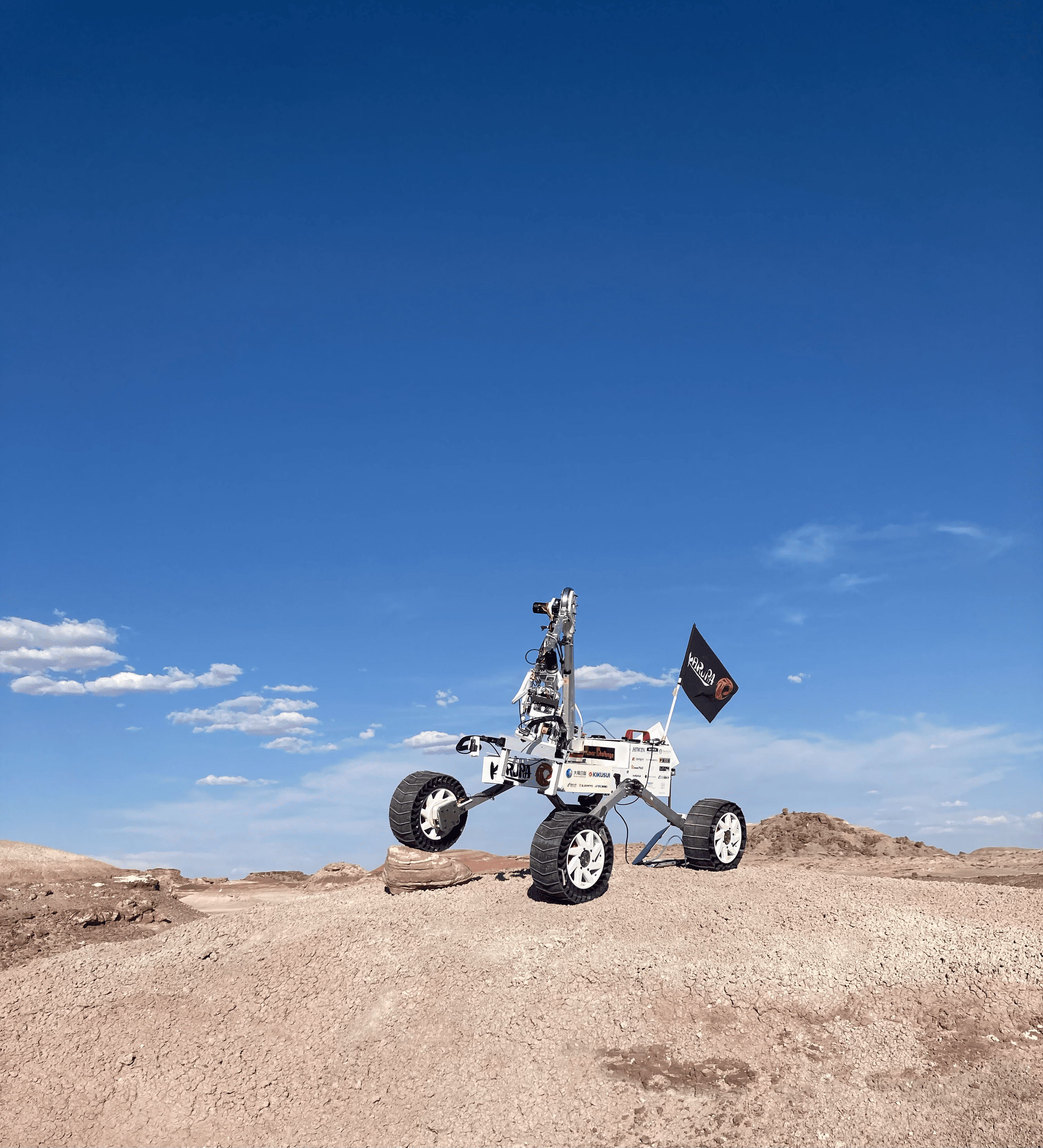
KARURA unites students from 30+ institutions across Japan and the U.S. to build, test, and compete with a Mars rover, and to show that international engineering collaboration at the student level is both possible and world-class.
Why We
Build Rovers
The University Rover Challenge is the world's most demanding robotics competition for university students, held every year on Mars-analog terrain in Utah.
KARURA was built on a simple thesis: the most advanced rover on the field should also be the most internationally diverse team on the field. We compete at URC every year, and in 2024 we proved that thesis true by reaching the Finals as the first Japanese and first international team in competition history.
Our mission is not limited to competition podiums. Every system we engineer, every student who joins from a new university, and every sponsorship we build moves the needle on international space collaboration as a practical, replicable model.
KARURA connects Japanese engineering excellence with the American aerospace research ecosystem at Texas A&M, combining complementary perspectives to solve hard engineering problems.
What Sets
Us Apart
True Cross-Pacific Structure
We are not an exchange program. We are a permanent dual-node organization with engineering operations running in Japan and Texas at the same time.
Competition-Proven Hardware
Every subsystem has been field-tested at URC on Mars-analog desert terrain. Our 2024 build reached the Finals, and the hardware performs under pressure.
Academic Network Depth
30+ institutions across Japan and the U.S., giving KARURA unrivaled access to diverse engineering talent and research resources.
Institutions
Students from these institutions form the engineering backbone of KARURA across all five departments.
Program
Timeline
Plan
Define subsystem requirements, establish hardware/software models, and set budgets.
Develop
Machine mechanical components, manufacture custom PCBs, and write autonomous navigation and control software to fully assemble the rover.
Test
Run hardware stress tests and field simulations to validate sensor feedback, debug software, and fix failure points before deployment.
Compete
Prepare for and pass the technical inspection process, then operate and maintain the rover in international competitions.
Departments
Hardware
Chassis · Suspension · Drive Train · Robotic Arm
Structural and kinematic design of the rover frame, four-wheel drive system, rocker-bogie suspension, and multi-DOF manipulator arm for terrain traversal and sample collection.
Electrical
Power · PCB Design · Motor Control · Sensors
Custom PCB design, power distribution architecture, brushless motor controllers, and sensor integration. Ensures system reliability under competition and environmental stress.
Software / Autonomy
ROS2 · Navigation · Computer Vision · Telemetry GUI
ROS2-based control stack, SLAM-driven autonomous navigation, computer vision for obstacle avoidance and task completion, and real-time telemetry UI.
Science
Astrobiology · Life Detection · Sample Analysis
Designs and validates scientific protocols for detecting biosignatures and soil chemistry. Manages the onboard spectrometry and microscopy payload.
Business & Outreach
Sponsorship · PR · Operations · Recruitment
Drives sponsorship acquisition, public communications, brand identity, and team logistics. Manages cross-cultural coordination between Japan and US nodes.